
Hurricane Season Planner Prep: Storm-Ready Spreads for Students
If you live anywhere near the Gulf, the season already made its introduction. Our first named storm came through last week, class got canceled, and now here we are: a thrown-off week, a shuffled schedule, and a to-do list that did not pause just because the weather did.
I have taught through enough of these seasons to know how it goes. The storm itself is rarely the hardest part. The hard part is the week after, when the power is back and the rain has moved on but your whole rhythm is off, assignments piled up, and you are trying to remember where you left your footing. If that is you this week, you are not behind. You are recalibrating, and there is a difference.
When the season doesn’t wait for you to be ready
Here is the thing I keep coming back to: a storm does not have to derail your term. The students who come through hurricane season steady are not the ones who were fortunate with the track. They are the ones who had a plan on paper before the watch went up. And if you did not have one in place this time, that is exactly what this week is for. You met storm number one. Let’s make sure storm number two does not catch you flat.
Why a storm plan is a study plan
When a storm is bearing down, your brain has zero spare capacity for figuring out where your flashcards are or what your instructor’s late-work policy says. Prep removes those decisions ahead of time, so when the power flickers you are calm and packed instead of panicking at midnight. A good storm spread protects two things at once: your safety and your semester.
The 5 storm-ready spreads to set up now
Build these into your Wonderland 222 (or whatever planner you love) while this season is still fresh in your mind. Set them up once, and the next system that pops up becomes a checklist instead of a crisis.
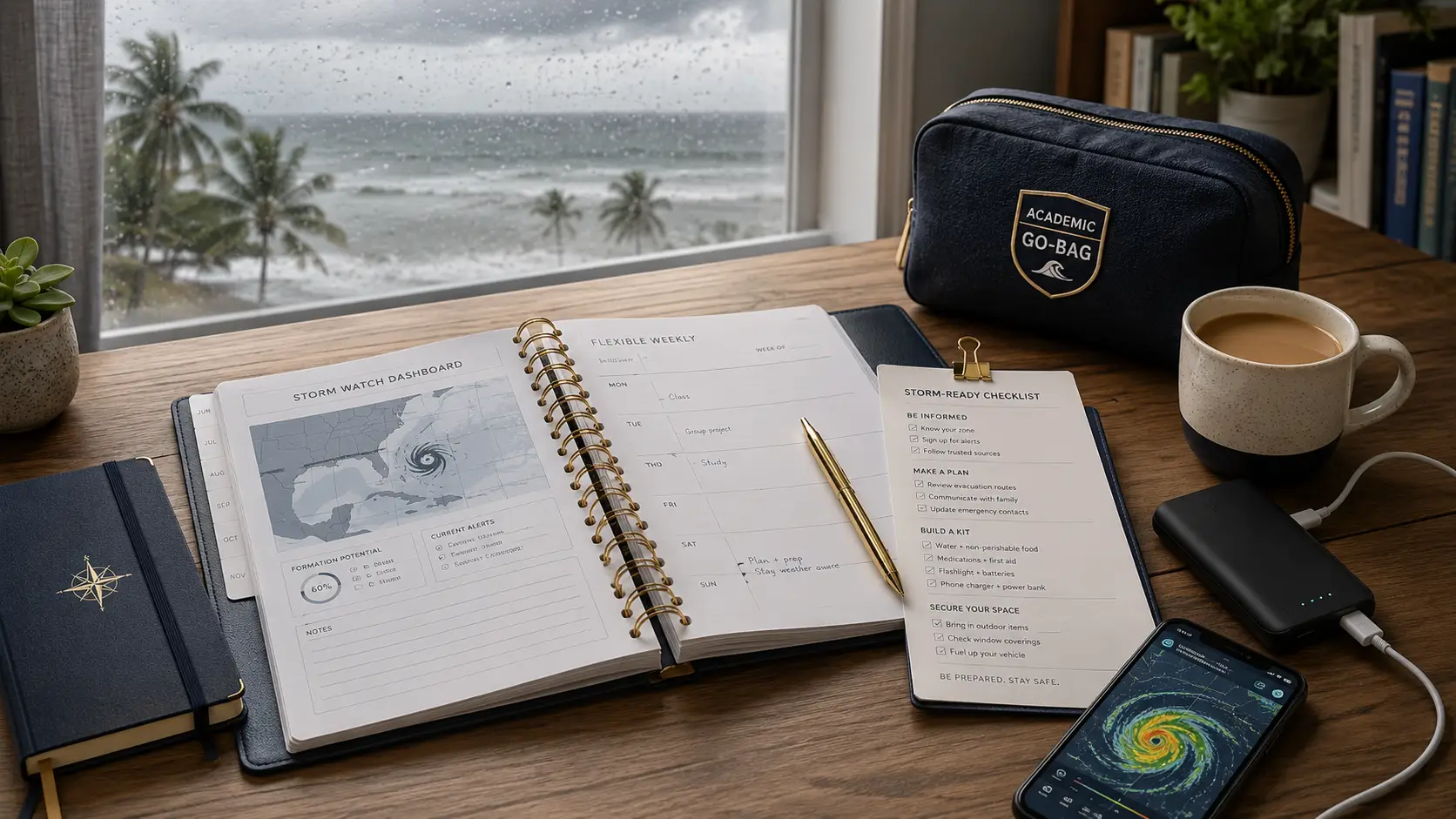
- The Storm Watch dashboard. One page to track the season: a running list of named storms, a simple watch and warning key, and a “prep-by” date you set the moment something enters the forecast. Seeing it on paper turns dread into a checklist.
- The grab-and-go academic kit. A checklist of everything your studies need to survive an evacuation or outage: laptop and charger, a power bank, offline copies of notes and flashcards, your logins written somewhere safe, textbook access, and your clinical site’s contact info. Pack the list, not just the bag.
- The flexible week spread. A weekly layout that can absorb a three-day power outage without collapsing. Keep priorities loose, leave white space, and pencil (do not pen) anything storm-week. Flexibility is a feature, not a failure. This is the spread that would have softened this past week, and it is worth building before the next one.
- The critical-contacts page. Your school’s emergency line and weather policy, each instructor’s email, your clinical coordinator, and how your program communicates closures. When a storm hits, you want this on one page, not buried in six different apps.
- The post-storm reset spread. The one everyone forgets, and the one a lot of us need this exact week. A gentle catch-up page for after the storm: what got missed, who to email, and a realistic re-entry plan so you ease back in instead of drowning in make-up work.
Resetting the week a storm already scrambled
If class got canceled and your schedule is now a patchwork of shifted due dates and make-up sessions, start here before you touch anything else. A canceled day rarely means one missed thing. It means a small ripple: the lecture you did not get, the lab pushed to a heavier week, the quiz that quietly moved.
Open your planner and do three quick passes. First, write down what actually moved, in one list, so it stops living as background noise in your head. Second, check your instructors’ updated dates against what you had penciled in, because canceled-class weeks are exactly when a deadline shifts and nobody quite registers it. Third, protect one realistic catch-up block this week and treat it like a class you cannot skip. You are not trying to make the week look normal. You are trying to make it survivable, and those are different goals.
Practical prep that takes 20 minutes
- Go offline early. Download your course materials, lecture slides, and flashcards for offline access the moment the next system shows up in the forecast.
- Screenshot everything. Screenshot your schedule, due dates, and clinical hours so they survive a dead Wi-Fi router.
- Charge the backups. A charged power bank is worth more than a planner sticker stash during an outage, and that is saying something.
- Know the policy. Find your school’s severe-weather and late-work policy now, while you are calm, not during landfall.
A little stillness in the chaos
Storm prep is practical, but it is also a quiet act of taking care of yourself. When the forecast is loud and everything feels uncertain, there is real peace in opening a planner and seeing that you have already handled what you can handle. Do the prep, then let the rest be what it is. You can be ready and still at the same time.
Your next step
If this week knocked you sideways, give yourself the rest of it to reset, then build these five spreads before the next name gets called. Future-you, sitting in a powerless living room with a fully charged power bank and offline flashcards, is going to be so grateful.
Want a head start? Grab the free Storm-Ready Student Checklist from PlanRx Insights and set up your storm spreads in one sitting.
🖊️ With purpose, a planner, and a pencil behind my ear.
– Mardesia